For years, many companies have invested in management systems, databases, spreadsheets, dashboards and internal reports.
The data exists.
The problem is that, in many cases, getting a specific answer still depends on requesting a report, searching through an Excel file, waiting for someone to prepare the information or navigating a dashboard that only answers questions defined in advance.
The information is there, but it is not always available at the exact moment when the business question appears.
And in the daily management of a company, many questions arise naturally:
- Which sales representative has sold the most this year?
- Which products have lost margin?
- Which customers have reduced their purchases this quarter?
- How have sales evolved by channel?
- Which orders are pending or show some deviation?
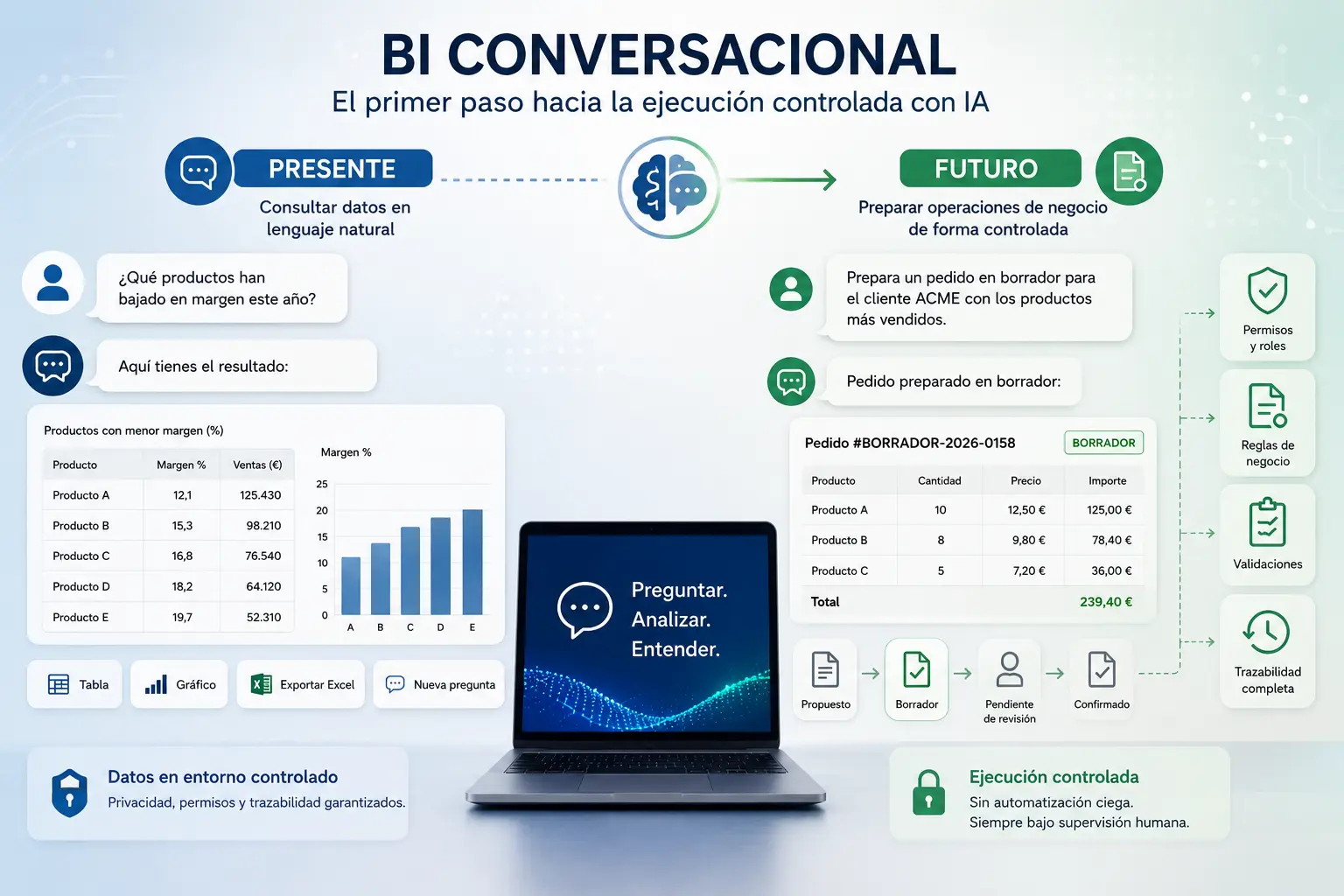
Conversational BI exists precisely to reduce the distance between a business question and a useful answer.
The present: asking business data in natural language
The idea is simple: allow someone to query company data by writing a question in natural language.
This is not about replacing every dashboard or eliminating existing reports. Dashboards remain very useful when questions are recurring, known and stable.
But not every business question starts that way.
Many questions appear during a meeting, while reviewing a deviation, comparing a period or trying to understand why a number does not match expectations.
In those cases, conversational BI makes it possible to explore information more directly:
- Ask in natural language.
- Get a table of results.
- Visualize the data as a chart.
- Export the information to Excel.
- Ask follow-up questions.
At Intercyd, we have prepared a conversational BI demo to show this approach in a practical way:
Try the conversational BI demo
The demo shows how the relationship with data changes when users do not have to adapt themselves to the available report, but can ask the question they need to answer directly.
From closed reports to a conversation with data
The value of conversational BI is not only the convenience of writing a question.
The important change is operational.
When a company depends only on closed reports, every new question can become a small interruption: someone has to prepare the data, modify a report, export information or manually review different sources.
This creates dependency, waiting times and loss of agility.
With a conversational layer over business data, many of those questions can be answered immediately, always within the information model defined for the company.
This is especially useful for management, sales, operations, administration or controlling teams, which often do not need a complex tool, but a clear and actionable answer.
Privacy, permissions and controlled environments
When we talk about artificial intelligence applied to business data, privacy cannot be a secondary detail.
Company data should not move freely from one system to another without control.
The right approach is not to send information without criteria to an external tool, but to build a query layer over a controlled environment, with permissions, traceability and validation.
This means the system must be designed to respect the real context of the company:
- Which data each user can query.
- Which information is sensitive.
- Which results can be exported.
- Which operations must be logged.
- Which limits must be applied in each case.
Artificial intelligence provides speed and a more natural interface, but data control must remain part of the design.
In enterprise environments, it is not enough for an answer to be fast. It must also be reliable, reviewable and governable.
The next step: from querying to preparing operations
Conversational BI represents the present: asking business data and receiving useful answers.
But the natural evolution will go further.
The next step will be systems that not only help understand what is happening, but can also prepare actions derived from that analysis.
For example:
- Prepare a draft order for a customer.
- Generate a commercial follow-up list.
- Create an internal task to review an issue.
- Prepare a commercial proposal.
- Generate a recurring management report.
- Leave an operation ready for review before confirmation.
This change matters because it means moving from a query tool to an operational tool.
But it also requires more control.
Controlled execution, not blind automation
Artificial intelligence should not have unrestricted access to company management systems.
That is not the right path.
The goal is not for AI to do things without supervision, but to prepare useful operations within a secure perimeter.
This means working with specific actions, defined rules, user permissions, intermediate states and complete traceability.
A simple example would be creating an order.
The system could interpret an instruction such as:
Prepare an order for this customer with these products.
But instead of directly confirming the operation, the reasonable approach would be to leave the order as a draft, with its lines, amounts and warnings, waiting for human review.
In this way, AI does not replace human judgement. It reduces manual work, prepares the operation and leaves it ready for validation.
The importance of the draft state
In real business processes, the draft concept is essential.
It allows artificial intelligence to help without automatically making decisions with economic, legal or commercial impact.
Preparing an order, a proposal or a task is one thing. Confirming it, sending it to the customer, issuing an invoice or permanently modifying a sensitive record is something very different.
That is why controlled execution should always rely on intermediate states:
- Proposed.
- Prepared.
- Draft.
- Pending review.
- Confirmed by the user.
This approach makes it possible to bring AI agents into real processes without turning them into operational black boxes.
AI agents, but governed
The trend towards AI agents is clear.
Systems will stop being limited to answering questions and will begin to assist complete processes: analysing information, detecting situations, proposing actions and preparing operations.
But in business environments, the key word should not be autonomy, but governance.
A useful agent is not the one that can do everything, but the one that can only do the right thing, with the right data, for the right user, while leaving a trace of every step.
This requires an architecture where each action is limited and controlled:
- What the agent can do.
- Which data it can work with.
- Which permissions it needs.
- Which actions require human confirmation.
- Which information must be logged.
- Which operations are forbidden.
That is the real challenge of artificial intelligence applied to enterprise processes.
From conversational BI to operational intelligence
Conversational BI is a very relevant first step because it changes how people access information.
But it also lays the foundation for something broader: systems capable of connecting analysis and operation.
First, we ask the data.
Then, we ask the system to help prepare an action.
Later, some operations may be partially automated, always within clear rules and with supervision when necessary.
The future will not simply be talking to data.
The future will be operating with data in a controlled way.
A natural evolution for companies
For many companies, the starting point does not need to be complex.
It can begin with a conversational BI layer over their current data, focused on common questions from management, sales, operations or administration.
From there, repetitive processes can be identified where it makes sense to move towards controlled actions.
The key is choosing the first use cases well.
It is not about automating everything, but about detecting those operations where artificial intelligence can reduce manual work, improve traceability and accelerate decision-making without compromising control.
Conclusion
The present already allows companies to query business data in natural language and receive answers as tables, charts or Excel exports.
That is what we show in our conversational BI demo:
But this is only the first step.
The natural evolution will be moving from querying to preparing operations: draft orders, internal tasks, proposals, reports, alerts or commercial actions.
Always under the same idea: applying artificial intelligence to business without losing control over data or operations.
AI can accelerate work.
But in business, speed only has value when it comes with security, traceability and judgement.