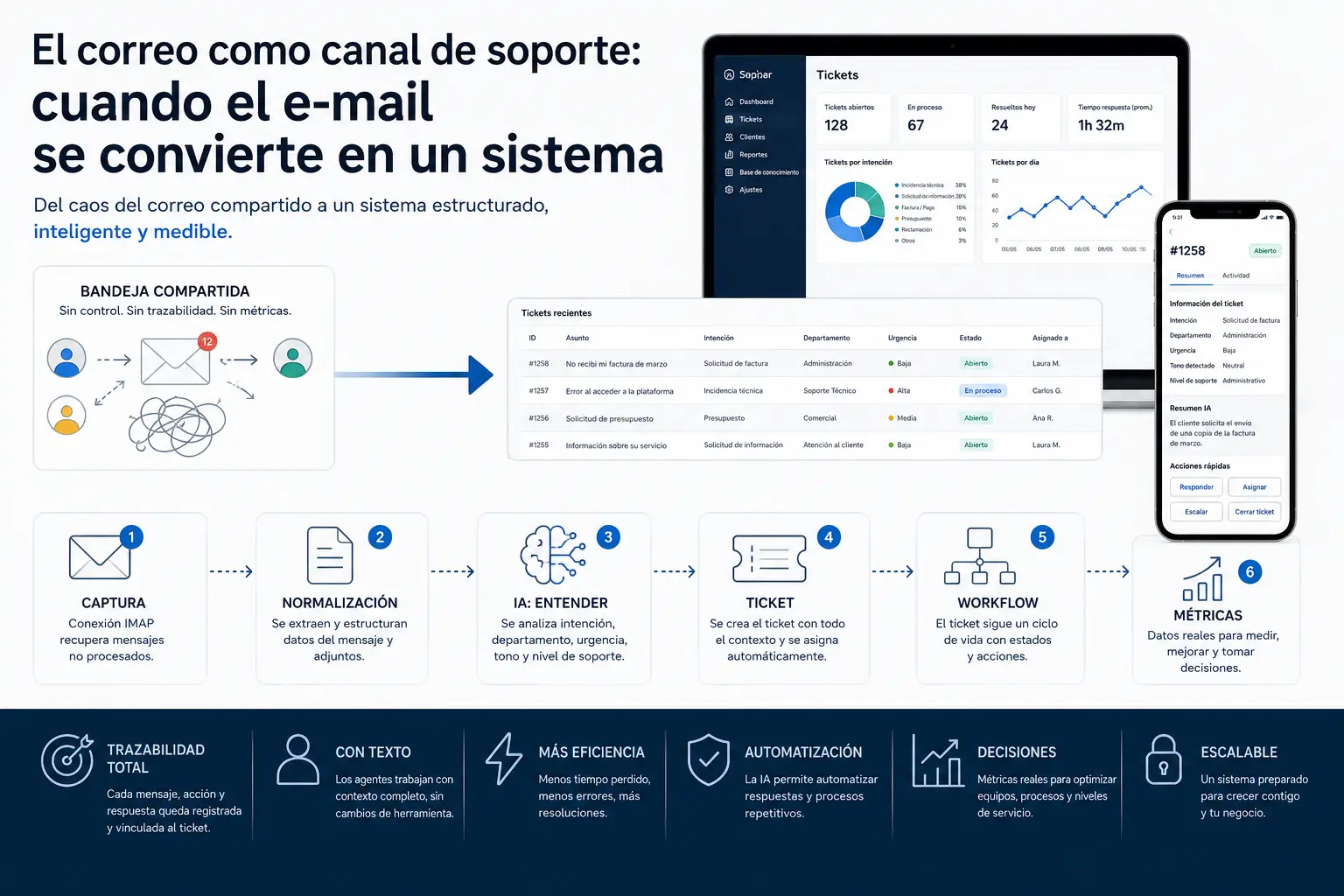
Most companies manage support through email. A shared inbox, multiple people with access, and no real control over what happens to each message.
The problem is not the channel itself.
The problem is that email was never designed to operate as a support system.
The starting point: a shared inbox
The scenario is common: a support, customer service or administration address receiving multiple types of requests.
Different users access the inbox from different mail clients, messages are marked as read by the first person opening them, there is no assignment, no traceability, and responses depend entirely on who happens to be available.
Scaling under this model becomes almost impossible.
Measuring performance is impossible too.
From inbox to system
The difference appears when email stops being treated as an inbox and becomes a structured workflow.
The goal is no longer to “read emails”, but to process business events.
Email → IMAP → Normalization → AI → Ticket → Workflow → Metrics
Every message stops being unstructured text and becomes structured, processable information.
Structured capture through IMAP
The first step is moving away from the mail client and building a dedicated ingestion layer.
Using IMAP, the system periodically retrieves unprocessed messages from the centralized account.
Each message is normalized:
- Sender
- Subject
- Plain text body
- Attachments
- Headers
- Reception metadata
This process does not depend on any user opening the message.
The system operates autonomously while keeping full control over:
- Pending messages
- Processed messages
- Errors
- Reprocessing
The database registers every capture.
Nothing gets lost.
Nothing gets processed twice.
Email stops being just text
Once normalized, the message stops being simply an email.
It becomes structured data that the system can operate on.
This is where artificial intelligence enters the workflow.
Not as a binary classifier, but as a comprehension layer.
The role of AI: understanding intent and context
The model analyzes the message and extracts structured signals:
- Intent
- Department
- Urgency
- Tone
- Estimated support level
For example:
- Information request
- Technical issue
- Complaint
- Quote request
- Invoice request
- Order processing
The goal is not simply tagging the message.
The goal is generating operational context.
A simple example
An email like:
“Hi, I need a copy of the March invoice because I cannot find it.”
can automatically become:
- Intent: invoice request
- Department: administration
- Urgency: low
- Identified customer
- Ticket linked to the correct history
The agent no longer starts from scratch.
The agent starts with context.
From message to ticket
Using those extracted signals, the system automatically generates a ticket inside the internal platform.
The ticket inherits:
- The original email
- Attachments
- AI analysis
- Priority
- Detected context
- Related history
The entire communication thread remains linked to the ticket.
Everything stays centralized, structured and traceable.
A real support platform
Ticketing is not simply an inbox with labels.
It is a business system.
Each ticket has a defined lifecycle:
- Open
- Assigned
- In progress
- Escalated
- Resolved
- Closed
Transitions between states are controlled and registered.
No ambiguous states exist.
Operations and workflows
On top of that lifecycle, the platform allows:
- Assigning tickets by department or workload
- Transferring tickets with full context
- Automatically escalating specific cases
- Replying directly from the platform
- Maintaining the full communication thread
- Registering audit logs and actions
Email still exists as the communication channel.
But operations no longer depend on email itself.
Real metrics instead of assumptions
One of the biggest problems with shared inboxes is the lack of useful operational data.
When support becomes a structured system, real metrics appear:
- First response time
- Average resolution time
- Tickets per agent
- Intent distribution
- Department accumulation
- Escalation volume
These metrics make it possible to detect:
- Bottlenecks
- Saturation points
- Staffing needs
- Recurring patterns
- Automation opportunities
Intent as the foundation for future automation
Intent analysis is not only useful for ticket classification.
It becomes the foundation for progressive automation.
For example:
- An invoice request can trigger an automated sending workflow
- A recurring order can be automatically validated
- A known technical issue can generate a suggested response
- Some requests can eventually be resolved without human intervention
Automation is not built all at once.
It is built in layers on top of a measurable, structured system.
Why this differs from conventional ticketing tools
Commercial ticketing platforms exist and work well.
The problem appears when they need external context.
When an agent needs to:
- Check customer status
- Validate an invoice
- Review an order
- Access commercial history
most tools force users to leave the system and consult other applications.
That creates:
- Duplicated work
- Context switching
- Lost time
- Operational mistakes
When the support system shares the same database and business logic as the rest of the operation, those queries can be solved directly from the ticket itself.
Without friction.
Conclusion
Email is not going to disappear as a business communication channel.
But continuing to manage it as a shared inbox has a real cost:
- Lost time
- Human errors
- Lack of metrics
- Dependency on individuals
- No scalability
Turning that channel into a structured system is not a complex technological problem.
It is a design problem.
The result is a support operation that is:
- Measurable
- Automatable
- Traceable
- Ready to scale
And that is where email stops being just email.