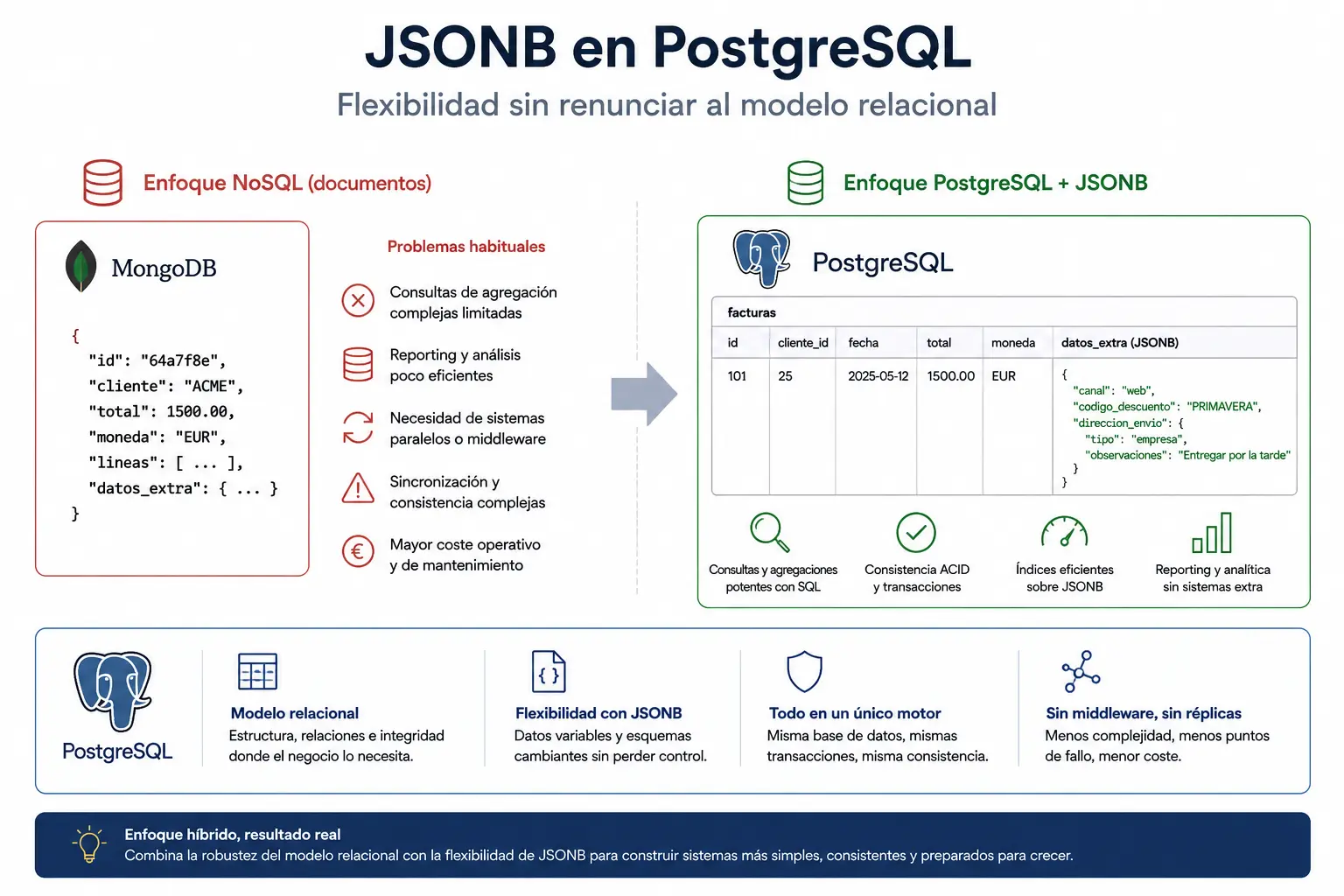
For years, many companies adopted NoSQL databases to solve a very specific problem: the need to store information whose structure changes constantly.
Products with different attributes depending on category, external integrations with variable formats, customer-specific configurations, or rapidly evolving datasets made the traditional relational model seem too rigid for certain scenarios.
MongoDB and other document-oriented databases offered an attractive answer: complete schema flexibility, fast initial development, and the ability to store information without defining every structure in advance.
The problem appeared later.
When those same systems started requiring financial reporting, traceability, auditing, complex aggregations, or real transactional consistency, many organizations realized they had simply moved the problem instead of solving it.
The hidden cost of separating flexibility and consistency
In many enterprise projects, the same pattern eventually appears:
- A NoSQL database for operations
- Another relational system for reporting
- Synchronization processes between both
- Duplicated data
- Growing complexity difficult to maintain
What initially looked like a flexible architecture ends up creating more failure points, more dependencies, and greater difficulty guaranteeing data consistency.
The issue is usually not the technology itself, but using a document-oriented flexibility model in domains where integrity and relational analytics are essential.
Especially in areas such as:
- Invoicing
- ERP systems
- Accounting
- Document management
- Traceability
- Enterprise process integration
In these environments, data consistency is not optional.
PostgreSQL’s alternative: JSONB
PostgreSQL has offered a different approach to this problem for years through the JSONB data type.
JSONB allows JSON documents to be stored natively inside PostgreSQL, not as plain text, but as structures that can be processed, indexed, and queried directly by the database engine.
That difference matters.
Flexible and structured data coexist within the same system, under the same transactions, the same query engine, and the same consistency guarantees.
There is no need to maintain parallel systems or synchronize information between different database engines.
The relational model remains where it provides value, while JSONB introduces flexibility only where it is genuinely needed.
The real value: a hybrid model
JSONB is not meant to replace traditional relational design.
Its real value lies in enabling a hybrid model where:
- Critical and structural information remains normalized
- Variable data can be stored flexibly
- The system keeps transactional consistency
- Analytical capabilities remain available
This approach is especially useful in scenarios such as:
- Products with variable attributes
- External API integrations
- Dynamic configurations
- Customer metadata
- Complete payload storage from external systems
What JSONB should not replace
Flexibility also has limits.
When data:
- Is queried constantly
- Participates in relationships between entities
- Belongs to integrity rules
- Is critical for reporting and analytics
traditional relational columns are still the correct choice.
JSONB does not remove the need for proper data modeling.
In fact, one of the most common mistakes is using JSONB as an excuse to avoid designing the business model.
The result is often a database that becomes difficult to maintain and whose structure depends entirely on the application layer.
Flexibility without losing analytical capabilities
One of the biggest advantages of the JSONB approach is that PostgreSQL allows flexible JSONB data to be queried, indexed, and combined efficiently alongside the rest of the relational model.
This makes it possible to:
- Perform complex aggregations
- Generate financial reporting
- Maintain traceability
- Combine structured and variable data
- Avoid parallel architectures
All within the same database engine.
An architectural decision, not a trend
The SQL vs NoSQL discussion is often presented as a technological competition when in reality it is an architectural decision.
Schema flexibility is a real problem and there are scenarios where document databases make perfect sense.
But in most enterprise systems, businesses eventually need more than flexibility:
- Consistency
- Traceability
- Reporting
- Integrity
- Analytical capabilities
JSONB makes it possible to introduce flexibility where it truly provides value without giving up the strengths of the relational model.
And in many cases, that prevents companies from discovering too late that complexity never disappeared — it simply moved somewhere else.