In most organizations, document management has shifted almost entirely to cloud services such as Google Drive, OneDrive or Dropbox.
These solutions are convenient, but they also introduce dependencies that are not always questioned:
- Where data is actually stored
- External access and usage policies
- Recurring costs
- Operational dependency on third parties
In many cases, it is assumed there is no real alternative. But there is.
The alternative: a controlled private cloud
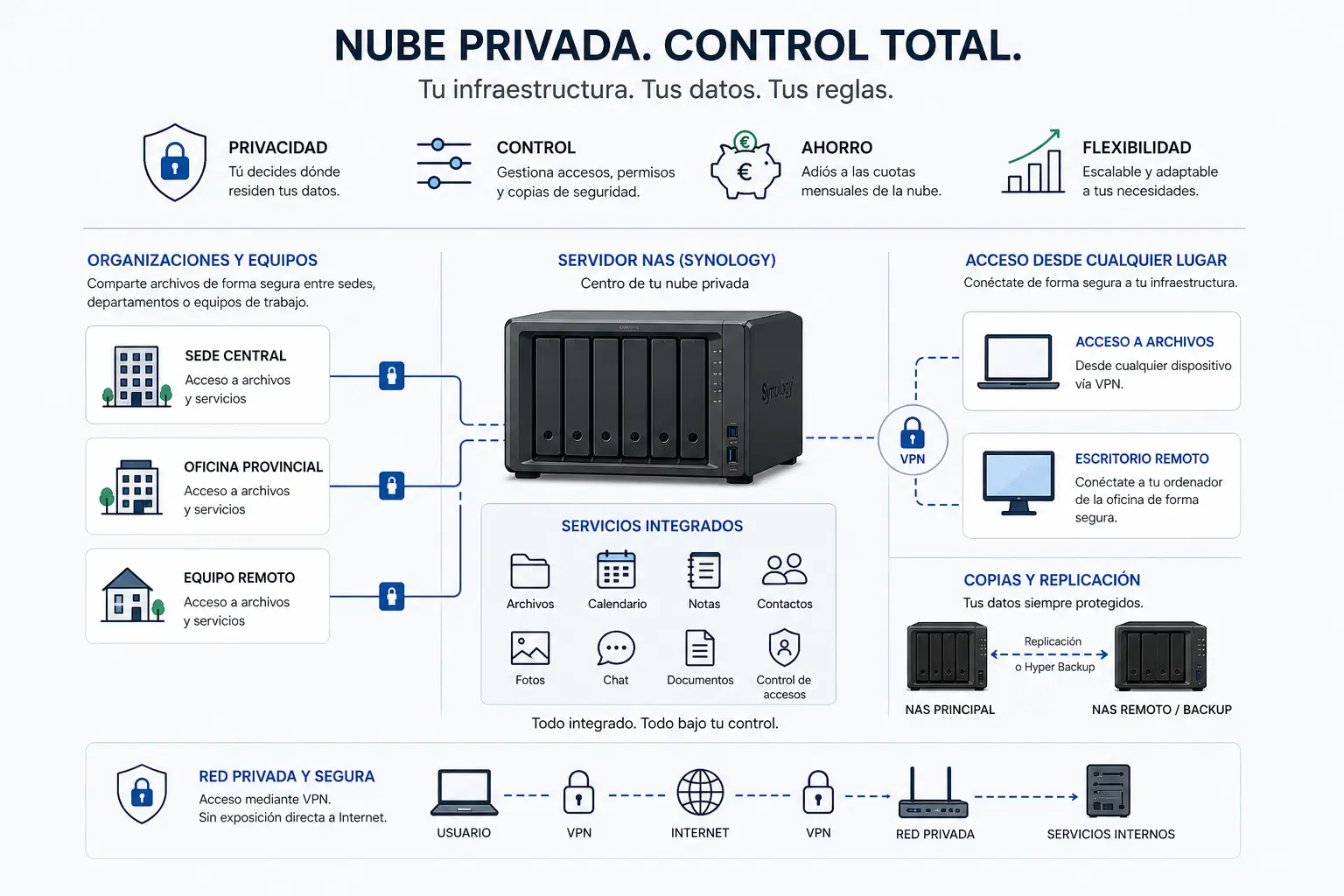
A viable option is to build a private cloud based on your own infrastructure.
This is not about replacing public cloud entirely, but about regaining control where it matters:
- Sensitive data
- Internal documentation
- Client file exchange
- Distributed work environments
This approach allows systems to be aligned with real business needs.
Real-world use cases
This model is already being applied in different scenarios:
- Distributed teams and remote work environments
- Private file sharing between organizations
- Secure document intake from clients
- Partial or full replacement of cloud storage services
Simple, well-designed infrastructure
These solutions do not require complex architectures, but well-defined decisions:
- Centralized storage
- Secure remote access via VPN
- Backup and replication systems
The result is a controlled, predictable infrastructure tailored to business needs.
A platform, not just storage
These solutions are often seen as simple storage systems.
However, platforms like Synology provide much more, covering many typical cloud functionalities within a private infrastructure.
In practice, this includes:
- File management and synchronization
- Shared calendars
- Notes and internal documentation
- User and permission management
- Automated backups
- Basic collaboration tools
This reduces the need for multiple external services, consolidating functionality into a single platform.
As part of the same ecosystem:
- Services are natively integrated
- Access control is unified
- Management is simplified
In many cases, this is not just about replacing storage, but about rebuilding part of the working environment on a more controlled foundation.
Privacy and control
One of the main benefits is visibility over your data:
- Where it is stored
- Who accesses it
- How it is managed
- How it is backed up
This is especially relevant in environments dealing with sensitive information.
When this approach makes sense
- Small and medium-sized businesses
- Organizations handling sensitive data
- Distributed teams needing control
- Cases where third-party dependency is an issue
When it may not be the best fit
- Large globally distributed teams
- Heavy real-time collaboration requirements
- Strong dependency on SaaS ecosystems
Conclusion
Public cloud has solved many problems, but it has also introduced new dependencies.
Today, it is possible to design more controlled alternatives based on private infrastructure.
It is not about eliminating the cloud, but about deciding when it makes sense not to depend on it.