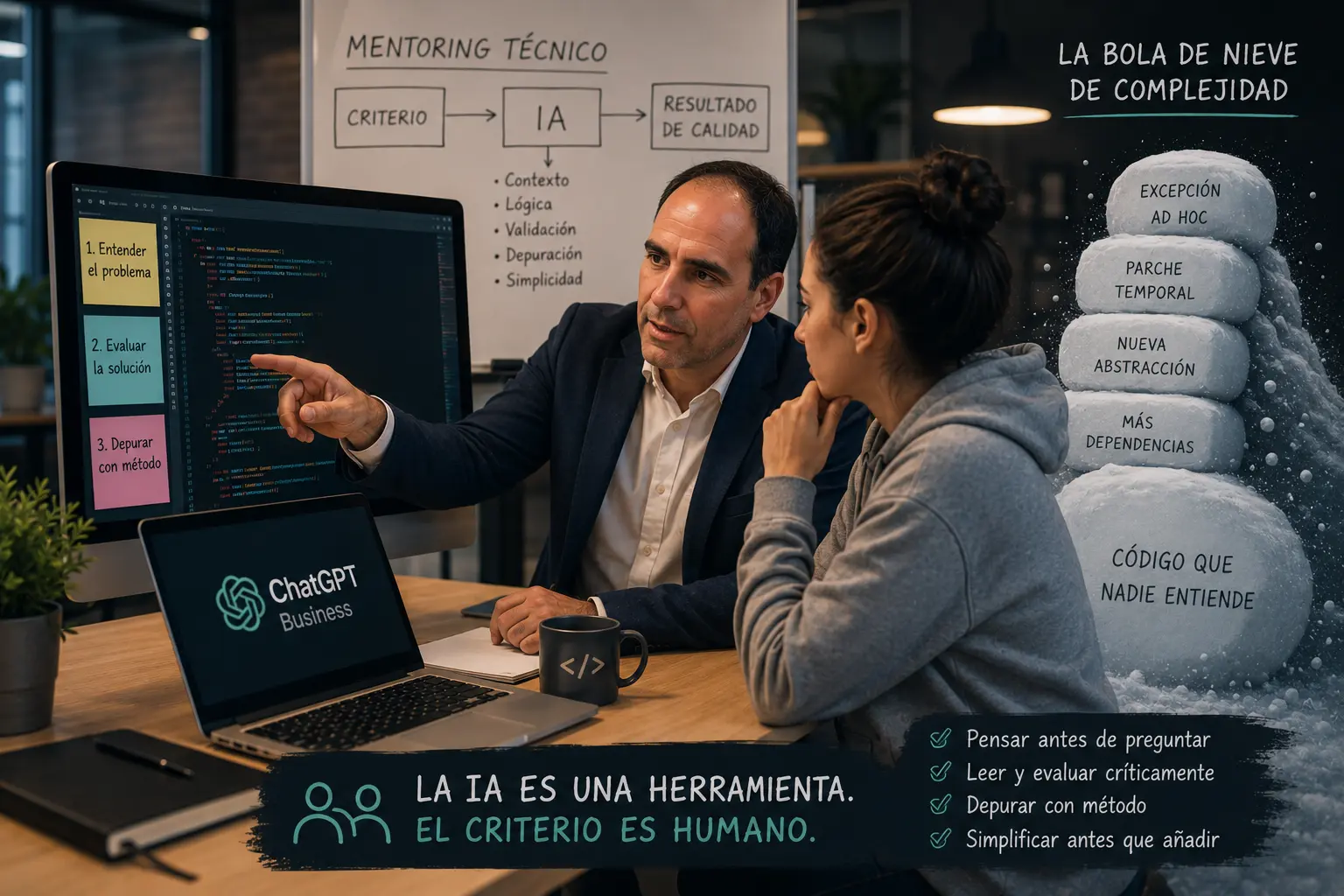
There is a scene becoming increasingly common in development teams. A junior developer delivers code that works. Someone asks what a specific part of the program does. They cannot explain it.
Not because they are careless. But because they did not actually write it themselves.
A change that is already happening
The integration of tools like ChatGPT, Copilot or Claude into the daily workflow of developers is no longer a future trend. It is already a reality across most technology teams.
And it is creating a new type of developer: someone capable of producing functional code without fully understanding what they are producing.
This is not necessarily negative. But it is not harmless either.
What AI cannot do for you
Using AI to generate code requires three capabilities that are not automatically acquired and cannot simply be delegated to the model.
The first is understanding what you need and how you need it.
AI does not understand business context, system constraints, unwritten requirements or previous architectural decisions. Translating all of that into a precise prompt still requires technical judgment.
Without that judgment, the result may work in isolation while failing in production.
The second capability is being able to read what the AI produces.
A program that compiles is not necessarily a correct program.
Recognizing that the logic does not solve the actual problem, that edge cases are missing, that the solution is fragile or that the approach itself is flawed requires critical code reading skills. Not necessarily writing skills, but comprehension.
The third capability is debugging when things fail.
And things always fail.
AI generates code with errors, incorrect dependencies and assumptions about environments that are not always valid.
Without debugging skills, development quickly becomes a sequence of prompts asking the model to fix what the model itself introduced.
The snowball effect of complexity
And this is where another problem appears, one that is still not being discussed clearly enough.
When developers do not fully understand the systems they are building, every issue tends to be solved by adding more AI-generated code:
- a new library,
- an additional abstraction layer,
- a temporary patch,
- or a special exception for a case that should not exist.
The problem is that AI almost always proposes another solution. But not necessarily a better one.
Little by little, the system enters a dynamic where every correction increases overall complexity.
The developer stops understanding the full flow and eventually reaches a point where simplifying, refactoring or rolling back becomes difficult.
Asking AI how to simplify a system that AI itself helped complicate rarely produces the expected result.
The outcome is software that partially works, that nobody on the team fully understands and that progressively becomes harder to maintain, debug and evolve.
This is not an isolated bug. It is technical debt silently accumulating until the cost of maintaining the system becomes higher than rebuilding it.
The system appears to move quickly until someone actually needs to maintain it, modify it or understand why it is failing.
This pattern is not created by AI itself. It is created by the absence of judgment around how AI is being used.
The role of mentoring in this context
The problem is not that developers use AI. The problem is that nobody is teaching them how to use it properly.
Companies have provided access to these tools without building proper processes around how they should be integrated into real-world development workflows.
The result is apparent productivity: code delivered quickly, functioning for basic scenarios, but not fully understood by the people maintaining it.
This is where technical mentoring gains a new kind of importance.
Not to teach syntax, but to teach developers how to think before writing the prompt, critically evaluate the output, debug methodically when something fails and recognize when the correct solution is not adding more code, but simplifying what already exists.
In this context, mentoring is no longer just about transferring technical knowledge.
It is about developing judgment.
And judgment is not generated by AI.
The new profile that actually makes sense
What is changing is not whether developers need programming skills to produce software. What is changing is the type of knowledge that truly matters.
Today it is possible to build functional software without fully mastering the syntax of a language.
But understanding the logic behind the system, reading the generated output and evaluating whether it actually solves the problem remains essential.
This is a different profile from the traditional developer. Not better or worse. Simply different, and still without a clear name inside the industry.
A role the market has not formally recognized yet
At Intercyd, we have been observing this pattern for some time, both in internal teams and in client environments.
The gap is not access to AI tools. The gap is the ability to use them intentionally.
The most valuable professionals are not necessarily the ones generating the most code with AI.
They are the ones who know exactly what to ask for, critically evaluate the result and take responsibility for the outcome.
That profile does not emerge automatically. It develops through guidance and mentoring.
The industry has spent years discussing the shortage of technical talent.
Perhaps the debate should shift: the challenge is not simply finding more developers, but training people to work effectively with the tools that will define how software is built from now on.
Conclusion
AI has changed what programming means.
But it has not removed the need to understand what is being built.
The challenge for organizations is no longer deciding whether teams should use AI. That decision has already been made.
The challenge is ensuring they use it with judgment.
And judgment is still developed by people.
Through time, practice and, in many cases, with someone experienced guiding them along the way.